


Shared Data Drives Better Results
SEO and paid search are often managed as separate strategies — even when they sit with the same agency or channel manager. Separate keyword lists, separate reporting, separate definitions of success. Each channel optimizes for its own metrics, with little visibility into what the others are learning.
That structure isn’t unusual. It’s just expensive.
When each channel manager builds a keyword strategy independently, the result is redundant work, uncoordinated messaging, and missed opportunities neither channel would catch alone. When each delivers a separate performance report, you’re left piecing together the full picture yourself. Which channel influenced that new lead? Which one started the conversation?
Single-channel reports can’t answer that. Budget decisions get made on incomplete information. According to reporting from Digiday’s 2026 Media Buying Summit, agencies that kept paid and organic search teams separate for nearly two decades are now integrating them — a direct response to how AI has changed search behavior. Gartner research reinforces why: 86% of marketing teams using siloed channel reporting struggle to define common success metrics, compared to 67% of those with a unified cross-channel view.
When vendors aren’t working from the same definition of success, you’re not just losing efficiency. You’re making investment decisions with a partial dataset.
The fix isn’t necessarily consolidating vendors. It’s getting them to share data and work toward the same goals. That’s what integrated SEO and PPC actually mean.
Using PPC Data to Make Smarter SEO Investments
SEO is a long game. A well-optimized page can take three to six months to rank — a timeline that’s manageable if you’re targeting the right topics. The problem is that most keyword research tools tell you how many people search for a term and how competitive it is. What they don’t tell you is whether those searchers actually buy anything.
Paid search does.
When a PPC campaign runs, it generates something organic research can’t: real-time conversion data. You learn not just which keywords drive clicks, but which ones lead to form fills, demo requests, or phone calls. Most keyword research tools, including SEMrush, classify keywords by intent — flagging terms as informational, navigational, or transactional. In theory, that helps you prioritize. In practice, those classifications are often built around consumer search behavior. They don’t translate reliably to B2B. A term that looks transactional in SEMrush may attract researchers or procurement teams doing early-stage due diligence, rather than buyers with a budget and a timeline.
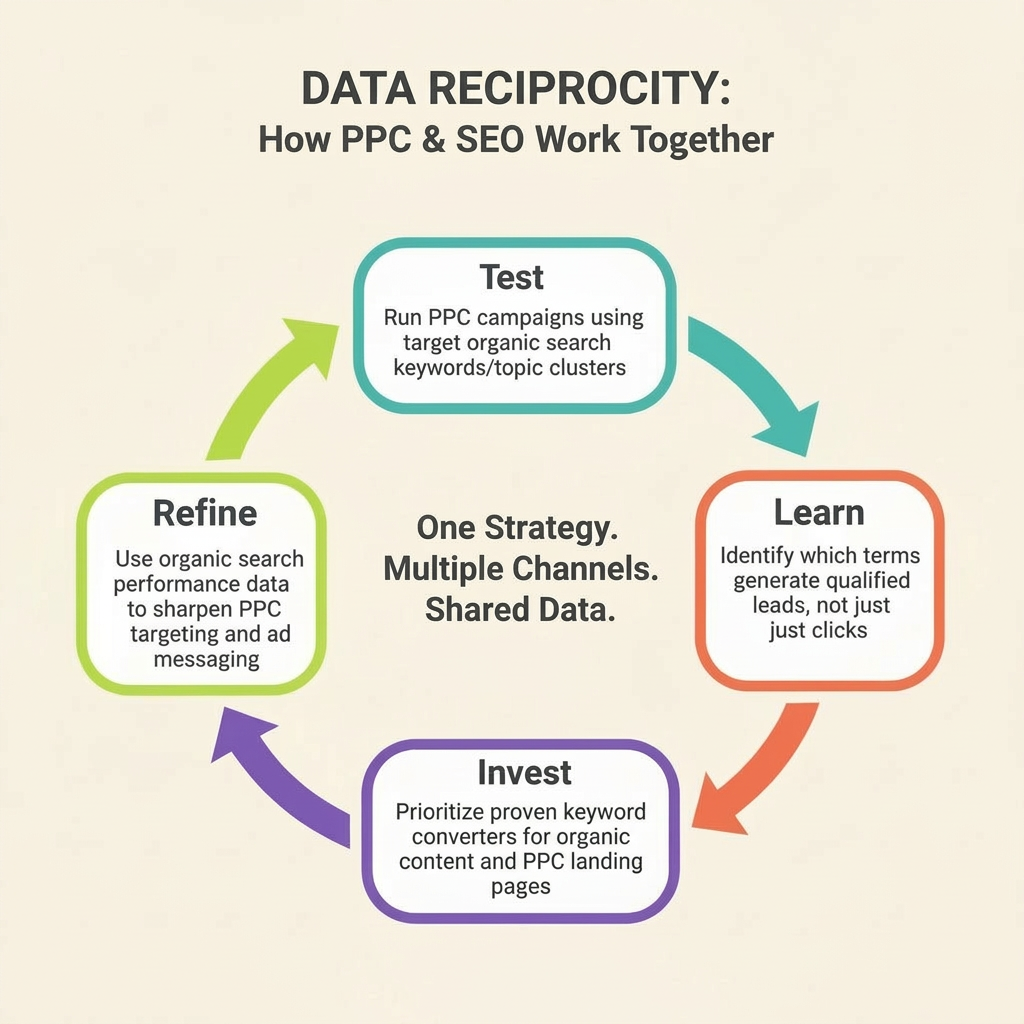
This is where the two channels start working for each other, and where a concept we call data reciprocity comes in. The idea is straightforward: instead of treating PPC and SEO as separate budgets chasing separate goals, you use what paid search proves to guide where organic effort goes. PPC spends a modest amount testing whether a keyword converts. SEO invests time and content budget in terms that have already demonstrated results. Each channel informs the other. That’s data reciprocity — the difference between an SEO strategy built on assumptions and one built on evidence.
A targeted PPC test answers the conversion question before you commit months of organic effort to the wrong topic. If it generates qualified leads, it becomes a priority SEO target. If it doesn’t, you’ve learned that efficiently, before months of content investment. This process — sometimes called PPC-to-SEO data mining — is one of the more underused advantages of running both channels together.
We’ve found that real results come from using PPC campaign data: search term reports, conversion rates, and ad copy performance. These inform which topics get prioritized for organic content. Pulling that into a unified dashboard means the picture is clear in one place rather than scattered across various platform reports. Having access to that data matters. Having an agency translate your data into decisions turns two separate channel investments into a coherent, integrated SEO and PPC services strategy.
A targeted PPC test answers the conversion question before you commit months of organic effort to the wrong topic.
Why Cross-Channel Attribution Matters More in B2B
B2B buying cycles often differ from consumer purchases. They unfold across multiple channels over weeks or months, often involving more than one decision-maker. A prospect might find you through organic search, read a blog post, and leave. Weeks later, they see a paid ad, forward your website to a colleague, and request a demo. Each step mattered.
A last-click report — which credits only the final interaction before a conversion — ignores all others.
That creates a real problem for marketing managers. It makes it difficult to defend the channels that started the conversation. If organic search introduced the prospect and paid search closed them, a last-click model makes SEO look unproductive. Budget pressure follows. The wrong channel gets cut.
Cross-channel attribution, in plain terms, means understanding which touchpoints influenced a prospect’s decision to reach out, not just the last one. When SEO and PPC data share a reporting environment, the resulting search synergy data reveals the full buyer journey. Not just who converted — but what convinced them. That changes how budgets are allocated and how they support data-driven marketing. Gartner’s 2025 CMO survey found that using data to optimize campaigns ranked as the top productivity strategy among marketing leaders. Every dollar spent now needs a story that leadership can follow.
A last-click report ignores all but one touchpoint. If organic search introduced the prospect and paid search closed them, the wrong channel gets cut.
What This Means for Your Business — and Where to Start
For mid-market B2B companies, the stakes of running disconnected search channels are higher than they might appear. Smaller marketing teams, often one or two people managing multiple vendors, don’t have the bandwidth to manually reconcile what each channel is learning.
Integration doesn’t require starting over. It requires a shared framework: one keyword strategy, one conversion definition, and one reporting view that everyone contributes to. When that’s in place, PPC stops being a short-term traffic lever, and SEO stops being a slow-burning hope. They become a feedback loop, each channel making the other more effective. A 2025 peer-reviewed study on organic and paid search confirmed that organizations that combined SEO and PPC saw higher conversion rates and stronger ROI than those running each channel independently. To see how this works in practice, read how we applied it for one client.
When you’re ready to explore what integrated SEO and PPC services could look like for your business, the best starting point is an honest look at where your channels stand today. We review your current SEO and PPC performance together, not separately, to identify gaps, redundancies, and the highest-value opportunities for integration. From there, we build a strategy your team can use, with reporting that gives you the evidence you need to make confident decisions and defend your budget internally. Not sure where to begin? An SEO audit, a PPC audit, or an analytics review can each surface where your channels are working at cross-purposes — and where the biggest opportunities are. Or, simply schedule a free strategy call — no pitch, just an honest look at what the data shows.