

Connecting The Dots
Most mid-market B2B companies aren’t short on content. They’re short on content that converts.
Marketing teams publish, rank, and watch traffic climb while pipeline growth stalls. The disconnect isn’t about production volume or creative quality. It’s about alignment: whether every blog post, landing page, and resource meets buyers where they actually are in their decision process.
Content Volume
More pages don’t always create
more pipeline
Buyer
Intent
Each search signals a different need or buying stage
Content
Gaps
Libraries often miss decision-stage content
Revenue
Path
Strong content points buyers to the logical next step
Before AI reshaped content production, writers used mind mapping to visualize how ideas connected on a single page. It worked because the problem was narrow: a person sitting with a blank page, trying to generate angles. That problem is mostly gone. The harder work today is getting the right content in front of the right buyer at the right stage of a much longer journey. Algorithms and AI systems decide who sees it at all, which means content has to satisfy two audiences: the human reading it and the bot deciding whether to surface it. Miss the bot, and the human never gets the chance. Search intent mapping solves that shift.
Key takeaway
More content does not automatically create more qualified leads.
Content has to match the buyer’s intent, stage, and their next decision.
Why “More Content” Isn’t Moving Your Pipeline
On paper, content marketing is working. 91% of B2B marketers use it as a core tactic, according to the Content Marketing Institute. In practice, 40% of those same marketers say creating content that drives a desired action is their top challenge. Production has never been easier. Converting the reader has never been harder.
The buyer journey is longer and messier than it used to be. According to Dreamdata’s 2026 LinkedIn Ads Benchmarks Report, the average B2B purchase now takes 272 days, with 88 touchpoints and 10 stakeholders. Ten different job titles, reading different content at different stages over most of a year. A single “what is X” blog post doesn’t survive that kind of journey. Neither is it a library of disconnected articles.
Marketers are also losing visibility into how content performs. Zero-click searches, where Google answers the question directly on the results page and no one visits a site, are now the norm. When an AI Overview appears at the top of a search, traditional clicks drop from 15% to 8%, according to Pew Research. Much of the buyer research happens in places marketers can’t see: private LLM sessions, peer communities, LinkedIn feeds, vendor review sites. Pipeline insight is harder to assemble when the data trail is full of gaps.
The CEO watches forecasting get shakier. The Marketing Manager watches dashboards that once told a clear story go dark in patches. Both face the same question from leadership: Is this actually working?
The buyer journey is longer and messier than it used to be. The Average B2B purchase now takes 272 days, with 88 touch points and 10 stakeholders.
What Search Intent Mapping Actually Does
Search intent mapping organizes content around what a buyer is trying to accomplish when they search, not just the words they type. Most B2B topics produce a range of queries across the buyer journey, and each query signals a different intent. “Content marketing” is a learning query. “Content marketing vs. demand generation” is a comparison query. “B2B content marketing agency pricing” is a buying query: same general topic, three different searches, three different intents, three different pieces of content.
That’s how you avoid cannibalization. Cannibalization occurs when two or more pages on your site compete for the same search query, splitting the ranking signals search engines use and often causing both pages to underperform. Rather than writing multiple posts targeting the same phrase, you map the range of queries around a topic, group them by intent, and build one strong page for each intent. Search engines and AI systems then have a clear signal about which page to surface for which search.
Most intent falls into four categories, and each maps to a stage in the buyer journey:
- Informational intent (Awareness): The buyer is learning. They’re trying to understand a concept, a problem, or a category. Example: “What is search intent mapping?”
- Commercial intent (Consideration): The buyer is comparing. They’ve identified a possible solution and are evaluating approaches or providers. Example: “content strategy vs. SEO strategy.”
- Transactional intent (Decision): The buyer is ready to act. They’re looking for a specific provider, a specific price, or the next step. Example: “B2B SEO audit pricing.”
- Navigational intent (Any stage): The buyer already knows who they want and is searching for them directly. Example: “Spectrum Group Online.”
Without Intent Mapping
With Intent Mapping
A content library — your website’s pages, blog articles, resource guides, and FAQs — rarely converts well when it treats all four intents the same. Awareness content written like sales copy loses the learner before the second paragraph. Decision content written like a 101 guide sends a qualified buyer back to Google. Getting the match right is the difference between content that ranks and content that sells.
Intent mapping sharpens the old mind-mapping technique. Rather than radiating outward from a single keyword to generate related ideas, a search intent map follows a different logic. Instead of asking “what else could we write about this?” it asks “what is the buyer trying to do here, and what does the next piece of content need to accomplish to move them forward?” The output isn’t a list of post ideas. It’s a structure that connects every piece of content to a specific buyer stage and a specific outcome.
For B2B specifically, that structure has become essential. Buyers arrive at sales calls having already consumed dozens of pieces of content across the web, LinkedIn, and LLM sessions. By the time a prospect books a call, they often know more about the category than the sales rep expected. Sales conversations have started to feel like technical interviews. If your earlier content didn’t match the buyer’s actual question, they’ll skip past it on their way to a competitor who did.
Where Most B2B Content Libraries Go Wrong
Most mid-market content libraries weren’t built. They accumulated. A blog post here, a landing page there, a whitepaper someone ghostwrote three years ago. Over time, the pile gets large enough to feel like a strategy. It isn’t. It’s inventory.
When you audit that inventory against buyer intent, the same patterns show up over and over:
Top-heavy on awareness, thin on decision.
Most libraries consist of “what is” and “how to” posts aimed at readers who are still figuring out what they need. Decision-stage content (like comparison guides, ROI breakdowns, pricing context) is either sparse or missing.
Posts that don’t talk to each other.
Each article lives on its own island. No internal links are guiding a reader from an awareness post to a consideration post to a service page. Each piece has to do all the conversion work on its own, and almost none of them can pull it off.
Readers finish an article with no path to pages that close deals.
The pages that actually close business — service descriptions, audit pages, pricing — sit disconnected from the blog content meant to feed them. A reader who lands on a smart awareness-stage article has no clear path to the service that solves their problem.
Overlapping posts compete against each other for ranking.
Two or three articles written months apart by different hands, all targeting the same phrase. You’re witnessing search query (keyword) cannibalization in the wild.
Content built on outdated optimization practices.
Keyword-stuffed headers, thin posts padded to hit a word count, weak internal structure. These pages may have ranked once. They don’t hold up in an AI-driven results page.
What ties these patterns together isn’t a lack of effort. It is content production running ahead of content strategy. Each post might be well written. The library as a whole doesn’t move buyers toward a legitimate sales conversation. That failure looks different depending on the searcher’s role. CEOs see organic traffic metrics that don’t translate into a qualified pipeline. Marketing Managers publish consistently, but can’t draw a clean line from output to revenue.
Ready to Get Found in the Age of AI-Assisted Search?
How Intent Clusters Connect Content to Revenue
The fix starts at the end of the journey, not the beginning. Most content planning works forward: identify topics, produce posts, and hope conversions follow. A search intent map works backward. It starts with the pages that close business and asks what questions a buyer needs answered before they’re willing to land there.
Those anchor pages are usually service pages, audit offers, or pricing pages. From each one, you trace the buyer’s path in reverse and group the questions by intent. Awareness-stage questions become one cluster. Consideration-stage questions become another. Decision-stage questions sit closest to the anchor. The result is a hub-and-spoke structure where every post has a job and a destination.
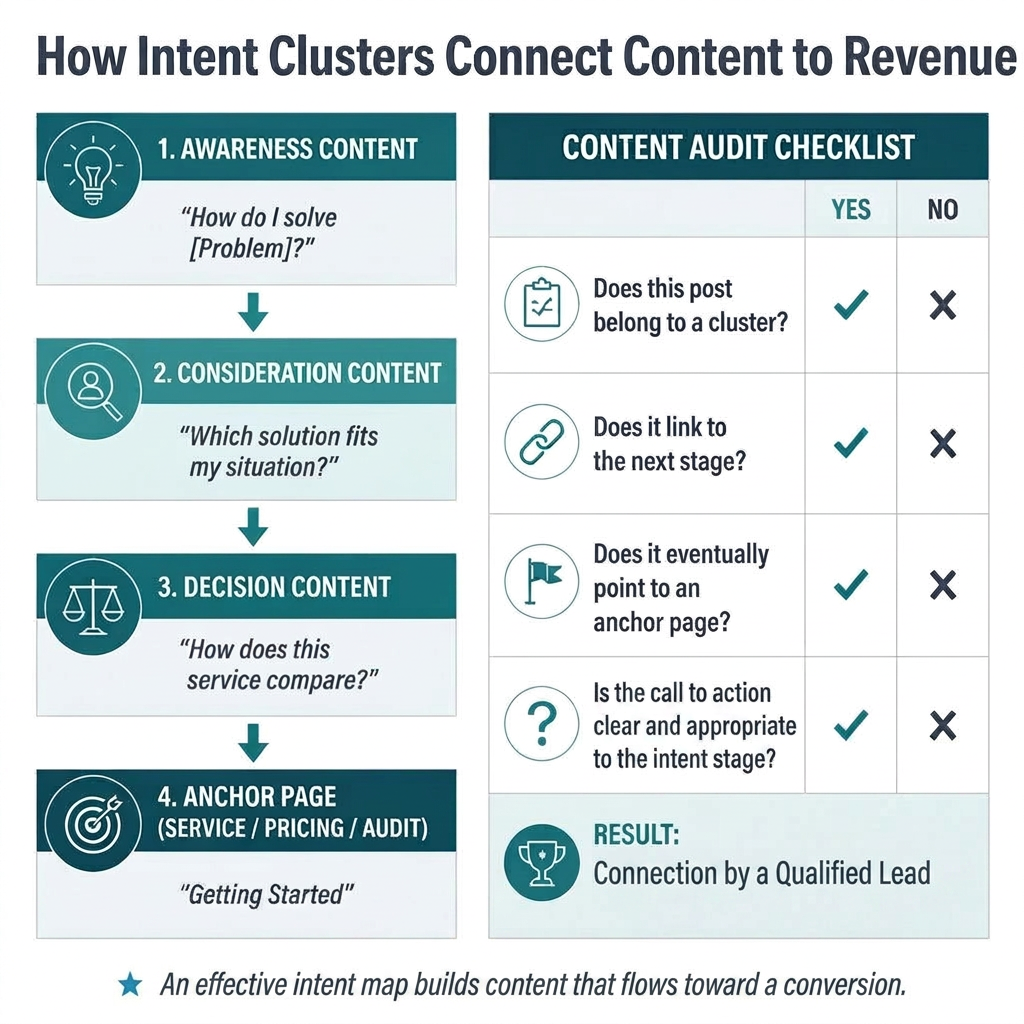
The revenue logic is simpler than it sounds. When a buyer lands on any piece of content in the cluster, the next step is obvious. An awareness post links to the consideration post that answers the follow-up question. That post links to the decision-stage comparison. The comparison links to the service page. Each piece pulls its weight. None are orphaned. And the cumulative effect over a 272-day buyer journey is what turns content from a line item into a revenue channel.
A working intent map also pays off for teams with limited headcount or resources. Once the map exists, every future content decision gets easier. New blog post? Check which cluster it strengthens and which anchor page it eventually points to. Old post underperforming? Check whether it matches any real intent or whether it’s an orphan from a previous strategy. The map replaces debates about what to write with a running list of gaps worth filling.
Why AI Search Raises the Stakes
Search intent mapping has always mattered. It matters more now because the gatekeepers have changed. AI Overviews, ChatGPT, and Perplexity now sit between a buyer’s question and a site’s content, deciding which sources to surface and which to skip.
Two things have shifted in favor of teams that map intent carefully.
- AI answer engines favor topical depth. LLM-powered systems draw on sources they judge authoritative for the entire topic, not just for an individual query. A company with a connected cluster on its core topic (a pillar page, supporting articles, decision-stage resources, and clear internal links between them) signals authority. Scattered posts on loosely related topics don’t. Clusters get cited in AI answers. Isolated posts usually don’t.
- Fewer measurable visitors, higher intent. Reported traffic from traditional search is down for many B2B sites, though some of that may be measurement issues (privacy opt-in throttling data) rather than an actual drop. Tools like Google Trends can help clarify what people are still searching for and where, even when site analytics don’t show the whole picture. What’s clearer is this: according to HubSpot’s 2026 State of Marketing Report, 58% of marketers report that visitors arriving from AI systems are further along in the buying journey and convert faster. They’ve already done the learning inside the LLM session. By the time they click through, they expect decision-stage content to be there. If a library is top-heavy with awareness posts, these higher-intent buyers bounce.
There’s a technical layer that makes all of this work better: schema markup. Schema is structured data added behind the scenes on a page (invisible to readers) that tells search engines and AI systems what the content actually is, whether that’s an FAQ, a product review, a pricing table, or the author’s credentials. Well-structured schema helps algorithms disambiguate content, extract facts accurately, and decide when to cite a source in an AI answer. For a cluster to earn placement in AI Overviews, schema markup shows how each piece gets tagged and understood.
Serving both audiences (humans and bots) isn’t two strategies. One piece of content gives each what they need.
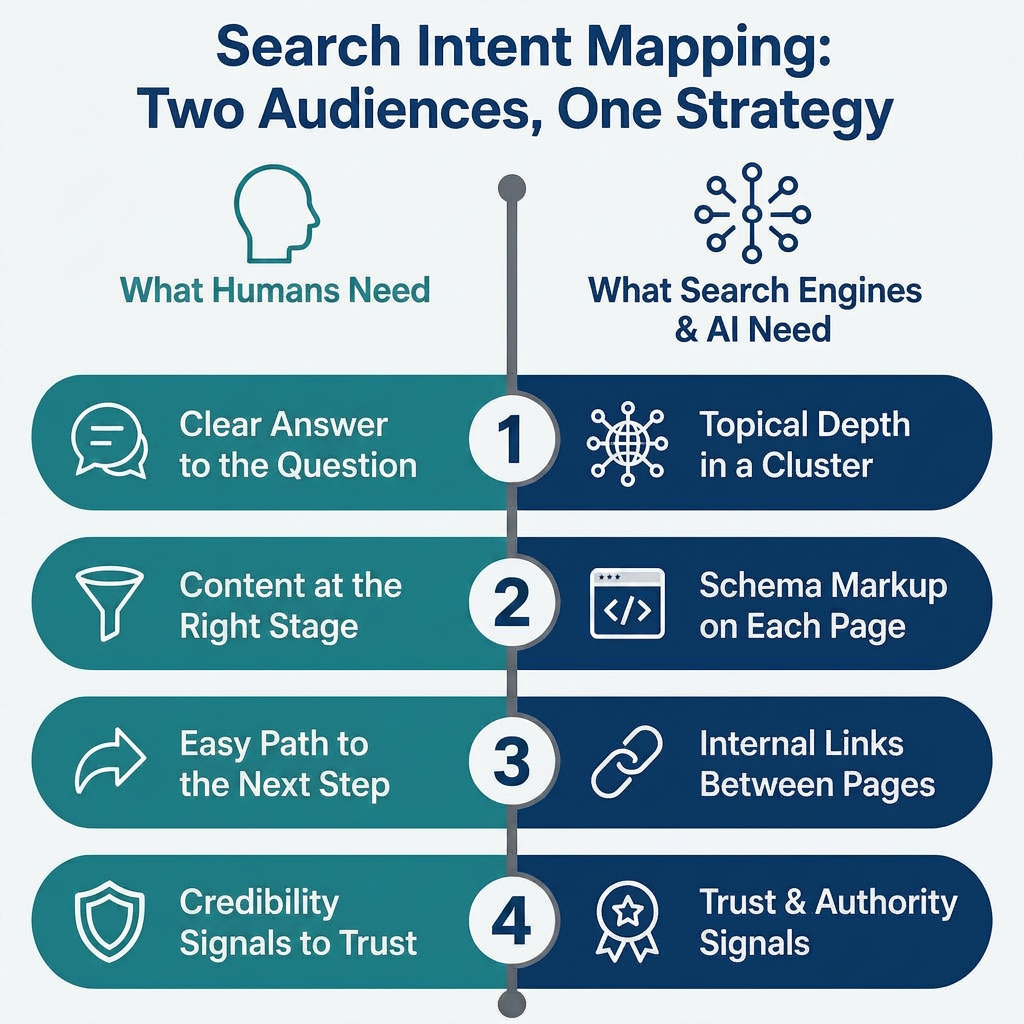
This shift has already changed what B2B sales calls feel like. Buyers arrive having consumed your content, competitor content, review sites, and potentially an in-depth conversation with an LLM. They come with specific questions about pricing, implementation, and the objections they’ve already identified. Sales conversations can feel like technical interviews. Strong content earns a chance for a sales conversation.
Why this matters
Intent mapping ties three things together: content clustered for authority, matched to where the buyer actually is, and linked to the pages that close deals. That’s how strong content earns a chance for a sales conversation.
From Brainstorm to Blueprint
Mind mapping earned its place as a way to get creatively unstuck. When the problem was a single blog post and a deadline, radiating ideas outward from a keyword worked. That problem has mostly been solved. AI can now generate a hundred post angles in the time it takes to make coffee. Production isn’t where B2B marketing teams are losing.
What hasn’t been solved is the harder question: which of those angles belong in your library, where they fit in the buyer’s journey, how they connect, and whether any of them move a prospect closer to a buying decision. That’s what a search intent map answers. It turns a list of topic ideas into a working plan, with every piece of content pulling toward a specific outcome.
A good intent map also does something most content strategies miss: it gives Marketing a reason to bring Sales into the room. Sales teams hear the real obstacles every day, the specific objections, the pricing pushback, the “we tried something like this before” stories, and the questions that come up on every third call. That knowledge rarely makes it into the content library. Mapping it closes the loop. The cluster gets stronger, the sales pipeline gets warmer, and the organizational silos start breaking down because both teams are finally working from the same map.
For a mid-market B2B team with a small marketing headcount, the payoff is practical. Fewer orphaned posts. Less content cannibalization. A clearer case to leadership when the next content budget gets questioned. And a library that earns its placement with both the reader and the algorithms deciding who sees it.
The first step isn’t rebuilding everything. It’s understanding what you already have and where the gaps are.
Start with a $2,000 SEO audit. We’ll review your content and search performance, identify where your library is working, and surface the gaps that matter most for your pipeline. The result is a clear picture of where to invest next, not a generic to-do list.
Ready to Get Found in the Age of AI-Assisted Search?
Let’s talk about your current SEO challenges and where to focus first.
Schedule your free, no-pressure strategy call.