


Questions That Go Beyond Rankings
The right SEO agency partner can help a mid-market B2B company strengthen visibility, reach the right audience, and create more qualified opportunities over time. Yet it is not always clear what to look for during the evaluation process.
Rankings and website traffic are naturally part of the conversation, but those numbers alone do not show whether search is supporting buyer fit, brand credibility, or meaningful sales activity. Surface-level gains can look promising at first without telling you much about the business impact behind them.
At the same time, search is changing, and the data is not as complete as it used to be — or as many teams expect. That makes it even more important to ask better questions, look past simple performance signals, and understand what meaningful SEO progress should actually look like.
This guide will help you evaluate SEO agencies more clearly, focus on the signals that matter most, and choose a partner that fits your business goals.
The Wrong Hire Is Expensive
Choosing the wrong SEO agency partner can cost more than your marketing dollars. It can pull attention away from the right priorities, waste internal time, and create false confidence in results that do not support meaningful business progress.
In B2B, that cost often shows up slowly. The work may look active on the surface, but it does not always improve visibility with the buyers you want to reach. It can push surface-level wins that do not support brand awareness, lead quality, or sales conversations.
A strong agency should understand how SEO supports the full buyer journey, not just search visibility. That is why the evaluation process matters.
A Changing Search Landscape
Search is changing. Buyers can get answers without clicking, and some now use AI tools to understand problems, compare options, and narrow providers before they ever visit a website.
At the same time, the available analytics data is less complete than it used to be. That makes it harder to rely on surface-level metrics alone and more important to choose an agency that can interpret the signals in front of you with sound judgment.
Why This Matters
A buyer may now discover your company in several ways before ever taking action. They may see your brand in organic results, encounter an AI-generated summary, compare providers through an AI assistant, or return later after several rounds of research.
That means the path from search to conversion is not always direct or fully visible.
It also means that your SEO strategy needs to support:
- visibility
- credibility
- clarity
- discoverability across changing search experiences
What to Look For
A strong agency should be able to explain:
- what the data can show
- what the data may miss
- how buyer behavior is shifting
- how strategy should adapt without chasing hype
The goal is not perfect visibility into every touchpoint. The goal is better interpretation and better decision-making.
What High Performers Do
Strong agencies do not panic when the landscape changes. They adjust their strategy, refine their expectations, and help clients stay focused on what still matters.
That often includes:
- strengthening technical foundations
- improving content quality and usefulness
- focusing on the pages that matter most
- watching how buyers discover and compare solutions
- helping internal teams understand the limits of the data
Red Flags
Be cautious when an agency:
- acts as if nothing has changed
- speaks in absolutes about what SEO can measure
- ignores AI-driven research behavior
- overreacts to every new trend without a clear business case
In a changing landscape, the strongest partner is usually the one that stays clear-headed.
Rankings and website traffic are naturally part of the conversation, but those numbers alone do not show whether search is supporting buyer fit, brand credibility, or meaningful sales activity.
SEO Is Not an Event
Strong SEO rarely comes from a single round of fixes or a single burst of content. It builds over time through technical improvements, better content, stronger measurement, and ongoing collaboration. Rather than a single event, SEO is a strategic partner.
That is why hiring an SEO agency should not feel like buying a one-time deliverable. It should feel like choosing a partner that helps your team make better decisions, set priorities, and adapt as search evolves.
Why This Matters
In B2B, SEO often supports a longer path to conversion. Buyers may read multiple pages, compare options over time, and return after internal discussions or outside research.
That kind of journey is hard to support with a one-time mindset.
A strategic SEO engagement should help your team think through:
- what to fix first
- what to improve next
- how content supports the buyer journey
- how technical and content work fit together
- what progress should look like over time
What to Look For
Look for an agency that can speak clearly about timing, collaboration, and prioritization.
A strong partner should be able to explain:
- what it would focus on in the first 90 days
- what should evolve over 180 days
- what longer-term progress may look like over 270 days and beyond
- how it works with internal stakeholders
- how it adjusts when the market or search behavior changes
That kind of thinking usually signals a more mature approach.
What High Performers Do
High-performing agency partners:
- set realistic expectations
- explain tradeoffs
- connect recommendations to business priorities
- work well with internal teams
- treat SEO as part of a broader growth effort
They do not just send reports. They help create direction.
Red Flags
Be careful when an agency:
- promises quick wins without context
- cannot explain how priorities change over time
- treats SEO like a checklist instead of an ongoing strategy
- shows little interest in collaboration with your internal team
That often points to a short-term mindset that will be hard to sustain.
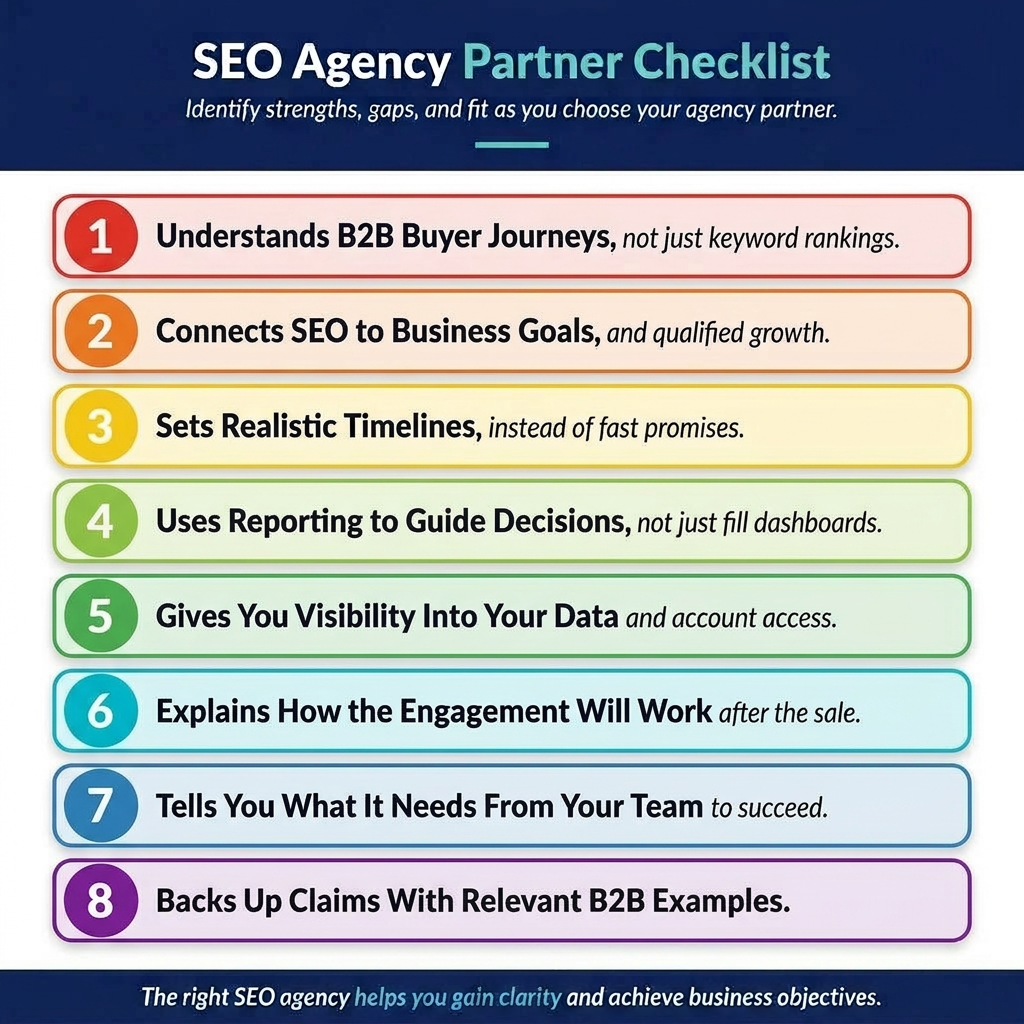
7 Questions to Ask Before Hiring an SEO Agency
The right questions can tell you a lot about an agency’s experience, judgment, and fit. The goal is not to hear perfect answers. These questions uncover whether the agency can connect SEO to your business goals, clearly explain its approach, and work as a strategic partner over time.
1. What is your experience with B2B organizations like ours?
B2B SEO requires more than general search knowledge. An agency may be technically capable but still miss the realities of niche audiences, multiple stakeholders, and longer paths to conversion. This question helps you assess whether the agency has experience with the visibility, trust-building, and demand-generation work that B2B organizations often need.
Why This Matters
B2B organizations face buyer journeys that involve complex decision-making and longer sales cycles. SEO often needs to support category education, solution comparison, and trust-building before a prospect is ready to act. That requires a different mindset than optimizing for quick, high-volume conversions.
What to Listen For
Look for an agency that can speak to:
- experience with B2B organizations, not just broad SEO work
- complex decision-making and longer sales cycles
- niche audiences or specialized offerings
- the difference between broad traffic growth and qualified opportunity
It helps if the agency has worked in your industry or a related space, but it should also be able to explain how it adapts to a new sector.
Red Flags
Be cautious when an agency:
- answers in general terms without showing B2B understanding
- talks mostly about traffic volume
- treats all SEO programs as if they follow the same playbook
- seems unfamiliar with the realities of B2B evaluation and buying behavior
These are signs the agency may not understand the kind of strategy B2B SEO requires.
2. How would you approach SEO for a company like ours?
A useful answer should show how the agency frames a new engagement before detailed discovery begins. You are listening for signs of judgment, curiosity, and whether the team can connect SEO to the realities of your market.
Why This Matters
An agency that defaults too quickly to tactics may be relying on a standard playbook. A stronger partner will first want to understand your audience, offerings, current visibility, and where SEO should support broader marketing and sales goals.
What to Listen For
Look for answers that include:
- a desire to understand your audience, offerings, and goals
- an explanation that strategy depends on business context
- a thoughtful approach to technical SEO, content, and visibility
- a sense that SEO should support broader marketing and sales efforts
The best answers usually sound curious, structured, and realistic.
Red Flags
Be cautious when an agency:
- jumps straight to tactics without asking questions
- offers a one-size-fits-all plan
- talks more about activity than priorities
- makes confident recommendations without enough context
These are signs the agency may be leaning on a template instead of real strategy.
3. What results should we realistically expect, and over what timeline?
This question helps set expectations before the engagement begins. A credible agency should be able to explain what early progress may look like, what takes longer, and what depends on stronger data, internal support, or site improvements.
Why This Matters
SEO is a long-term strategy. It can create strong compounding value over time, but it rarely works like a switch. A credible agency should explain how progress may unfold in phases and where expectations should remain realistic.
Results are only as useful as the data behind them. If analytics, conversion tracking, or reporting setup is incomplete, early decisions may need to focus on improving visibility into performance before the team can judge impact with confidence. That is especially true for organizations that are still improving how they track marketing performance and make data-driven decisions.
What to Listen For
Look for answers that describe:
- what may happen in the first 90 days
- what progress may look like over 6 months
- what stronger gains may take 9 to 12 months or longer
- how timelines depend on competition, site condition, content, and internal support
The strongest answers also make room for foundational work early on, including technical fixes, page improvements, better reporting, and stronger content support.
Red Flags
Be cautious when an agency:
- promises fast results without context
- guarantees rankings
- avoids talking about the time required
- treats SEO like a short campaign instead of a long-term effort
These are signs the agency may be oversimplifying the work or setting unrealistic expectations.
4. How do you report on SEO performance?
Reporting is one of the clearest ways to see how an agency thinks. A useful report should do more than summarize activity. It should help your team understand what is changing, what it means, and what decisions to make next.
Why This Matters
Reporting should support data-backed decisions, not just show movement in a dashboard. That matters even more now, when search data is not as complete as it used to be and not always as complete as teams expect. A strong agency should be able to explain what the data shows, what it may miss, and how it turns those signals into practical recommendations.
What to Listen For
Look for an agency that talks about:
- clear reporting cadence
- dashboards or summaries that are easy to use
- explanation of what matters most
- visibility into the data, including verified conversion tracking
- direct access to core accounts and platforms
- interpretation that leads to action
The strongest answers make it clear that reporting is meant to support better decisions, not just document activity.
Red Flags
Be cautious when an agency:
- relies on vague reporting
- hides behind overly complex dashboards
- cannot explain what leadership should pay attention to
- limits visibility into the data or core platforms
- speaks with more certainty than the data supports
These are signs the agency may be reporting on activity without helping your team make stronger decisions.
Reporting should support data-backed decisions, not just show movement in a dashboard.
5. Describe how we would work together.
This question helps you picture the relationship after the sale is over. It should clarify how the agency communicates, who is responsible for what, and whether the engagement will feel organized and manageable for your team.
Why This Matters
Even a strong strategy can stall if the working relationship is unclear. SEO usually depends on coordination across content, development, analytics, and internal approvals, so the agency should be able to explain how that collaboration works in practice.
What to Listen For
Look for clarity around:
- who your main point of contact would be
- who would actually do the work
- how strategy and execution are coordinated
- how often the team communicates
- how the agency works with internal stakeholders
- whether any work is outsourced, and how that is managed
The best answers should make the relationship feel clear, practical, and collaborative.
Red Flags
Be cautious when an agency:
- is vague about who will manage the account
- cannot explain who is responsible for deliverables
- makes collaboration sound heavy or confusing
- glosses over outsourcing or handoffs
- treats the relationship as a one-way reporting exercise
These are signs that the relationship may feel disjointed once the work begins.
6. What do you need from us to achieve SEO results?
This question sets expectations on both sides. A strong agency should show that SEO is a shared effort, not a service that runs well on guesswork or limited access.
Why This Matters
Meaningful SEO progress often depends on inputs the agency cannot create on its own. Priorities, approvals, subject matter expertise, site access, and internal coordination all affect how quickly good work can move forward.
What to Listen For
Look for answers that mention:
- clarity on priorities and goals
- access to the website and analytics tools
- insight into your audience and offerings
- input from sales, marketing, or subject matter experts
- timely feedback and internal coordination
The clearest answers show that strong results come from collaboration, not guesswork.
Red Flags
Be cautious when an agency:
- acts as if it needs nothing from you
- makes the process sound completely hands-off
- ignores the need for business context
- fails to mention internal alignment, approvals, or access
These are signs the agency may be oversimplifying the work or skipping important steps.
7. Share examples or case studies that show meaningful B2B outcomes.
At some point, the conversation needs to move from promises to proof. This question helps you see whether the agency can point to outcomes that resemble the kind of progress your organization wants to make.
Why This Matters
Case studies help you judge whether the agency has delivered results in situations that resemble your own. They also show what the agency chooses to emphasize: surface-level gains, or outcomes that connect more clearly to business progress.
What to Listen For
Look for examples that show:
- the challenge the client was facing
- the type of work that was done
- the timeline involved
- what changed over time
- the business relevance of the outcome
The most useful case studies are specific enough to be credible, even if some details must remain confidential.
Red Flags
Be cautious when an agency:
- shares only vague success stories
- focuses only on rankings or traffic spikes
- cannot explain the business context behind the results
- has no relevant B2B examples to share
These are signs the agency may be better at pitching than proving results.
Gain Clarity Before You Commit
If you are comparing SEO agencies, an audit can give you a more solid starting point. Instead of choosing a long-term partner based on a pitch alone, you get a clearer view of your current search performance, the obstacles holding you back, and the work that deserves attention first.
For mid-market B2B organizations, that kind of clarity matters. Rankings and traffic can be part of the picture, but they do not always show whether your site is reaching the right audience, supporting trust, or helping create qualified opportunities. An audit helps turn that broader question into something more concrete.
A strong SEO audit should help you understand:
- Where visibility is strongest today and where it is falling short
- Which technical issues matter most for search performance and site usability
- Whether your content matches buyer intent across different stages of the journey
- How well key pages support discovery, evaluation, and conversion
- Whether your analytics foundation and reporting are strong enough to support data-backed decisions
- What should be prioritized first, and what can wait
It should also show you how the agency thinks. Are the recommendations clear? Do they connect SEO work to business goals? Does the team explain the data in a way that helps you make decisions?
The value of an audit is not just the findings. It is the focus that comes with them. Instead of a broad promise to “improve SEO,” you get a clearer roadmap, better context for decision-making, and a practical way to judge whether the agency is the right fit for a larger engagement.
Get a clearer picture of your current SEO performance and which areas deserve attention first. Start with our SEO audit. It’s a practical first step to gain clarity, understand your options, and experience working with us.