

A Smarter B2B Long-Form Content Strategy
Many companies invest in content marketing on the simple assumption that longer content should perform better. A longer page has more room for keywords, more space to explain a topic, and more chances to rank.
That logic sounds sensible. It also leads to a lot of bloated content.
- A Smarter B2B Long-Form Content Strategy
- Does Word Count Matter for SEO and AEO?
- Why Content Depth Still Matters in AI-Assisted Search
- Why Most Long-Form Content Underperforms
- When Long-Form Content Makes Sense for B2B
- How Long-Form Content Builds Trust and Credibility
- How to Audit Long-Form Content for Conversion Gaps
- A Better Word Count Strategy for B2B
- Final Takeaway
Creating too many long-form posts just to hit word targets doesn’t help readers solve problems. They add length without adding clarity. They attract attention without supporting trust. In B2B, that is a costly mistake.
That is why a smarter conversation about word count and SEO has to go beyond page length. The real question is how content depth supports visibility, buyer understanding, and action.
The better question is not, “How long should this page be?” It is, “How much content does this reader need to understand the issue, evaluate the options, and take the next step?”
Does Word Count Matter for SEO and AEO?
Yes, but only indirectly.
If you are asking whether word count and SEO are connected, the answer is nuanced. Word count can influence performance when a topic requires a thorough explanation. A page about pricing strategy, implementation risk, or service comparisons often needs more depth than a simple definition post. In those cases, longer content can perform well because it covers the topic more fully.
Google’s own guidance makes the point clearly: there is no ideal word count for ranking well in search.
A short page can rank if the intent is narrow and the answer is clear. A long page can underperform if it is padded with repetition, vague advice, or generic commentary. Search engines and answer engines do not reward content because it is longer. They reward content that is useful, well-structured, and easy to understand.
Why the “ideal word count” question is misleading
The appeal of an ideal word count is obvious. It turns a strategic decision into a simple number.
That simplicity is also the problem.
Once teams start writing to a length target, the reader often loses focus. Short ideas get stretched into long posts. Broad background replaces specific answers. Pages end up organized around publishing habits instead of buyer needs.
A better approach starts with intent. What is the reader trying to solve? How complex is the topic? What follow-up questions are likely to come next? Those answers should shape the page.
When longer pages can outperform
Longer pages work when they answer more of the reader’s real questions, add useful context, and connect the topic to a decision.
That matters in B2B. A buyer may need enough depth not just to learn about the issue but also to explain it internally, compare providers, or justify action. When the topic is complex, a thin summary may feel efficient but still leave the reader unprepared.
Length earns its place when it helps the reader move from curiosity to understanding.
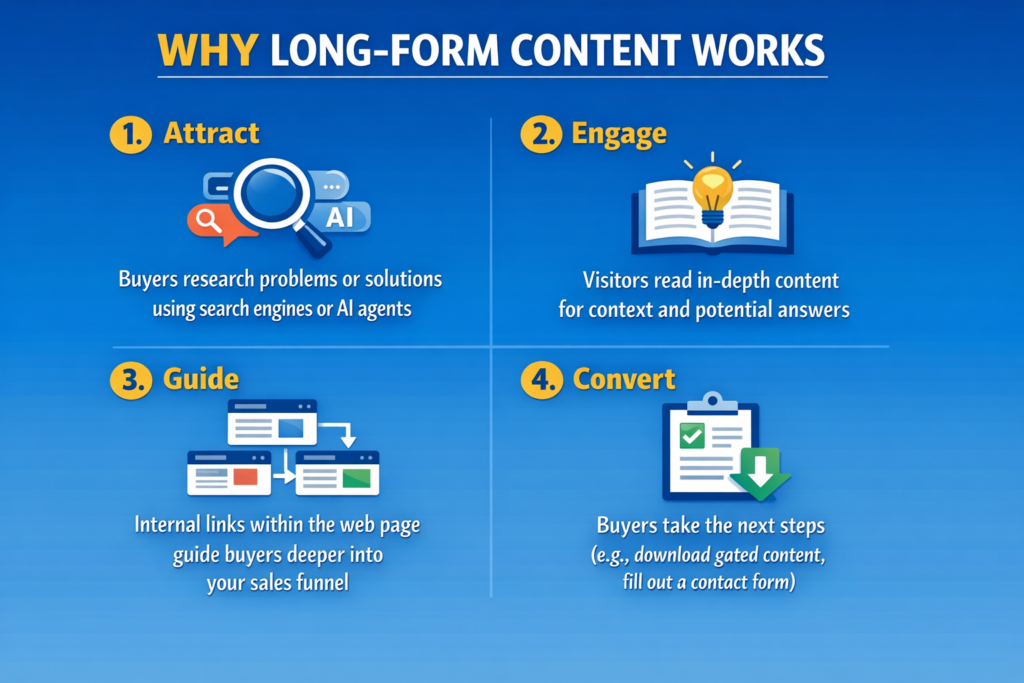
Why Content Depth Still Matters in AI-Assisted Search
AI-assisted search has changed how people research, but it has not removed the need for useful depth.
Buyers research their problems to better understand how to solve them. They still need context, comparison, and implications before they reach out to a provider or strategic partner. In many cases, that work happens earlier and more independently than it used to.
Buyers research problems before they contact potential providers
B2B buyers often use search engines and AI agents to define a problem, explore possible approaches, or sharpen internal thinking before outreach begins.
That makes informational content more commercially important than many firms assume. A page that supports early research may influence the buying journey long before anyone fills out a form.
Deeper content gives search and answer engines more context
A thin page may answer one surface-level question. A stronger page answers the main question and the related questions around it.
That added context helps readers and systems alike. Readers can build a more complete understanding without bouncing between shallow sources. Search and answer engines can interpret the page more confidently when the coverage is clear, structured, and connected.
The advantage comes from depth with clarity, not from length alone.
Brand recognition can start before the buying decision
Early visibility matters. If your content helps a buyer understand the issue before they are ready to evaluate providers, your brand can gain familiarity and credibility before the sales conversation begins.
Not every informational post leads straight to a sales pipeline. Still, useful content can shape who gets remembered later. For many B2B firms, that is one of the strongest reasons to invest in long-form content.
Why Most Long-Form Content Underperforms
Most long-form content does not fail because it is too long. It fails because the extra length is doing the wrong job.
Instead of helping the buyer make progress, it often buries the answer under long intros, repetitive explanations, and loose structure. The result looks substantial but feels slow.
Length without purposeful structure loses momentum
A technically organized page can still lose the reader.
That happens when the structure is not purposeful. It goes too deep too early. It gives equal weight to every detail. It makes scanners work too hard to find the point.
Different readers need different levels of depth. Some want fast answers and clear takeaways. Others want details because they are closer to the work. Decision-makers may care most about implications, tradeoffs, and next steps. Strong long-form content accounts for those differences by layering information rather than dumping it all at once.
Informational traffic is not the same as qualified demand
Traffic can make content look successful when it is not.
Many legacy blog posts attract broad informational visits but do little to support qualified demand. There is no bridge from education to evaluation. No logical path to a service page. No useful next step for a reader who is moving closer to a decision.
Adding high-intent content marketing in these instances can make a difference. The goal is not just to attract attention. It is to create content that brings in the right readers and helps them move toward a commercial decision.
For B2B teams, the better question is not whether the page attracts visitors. It is whether it attracts people who could become buyers, influencers, or internal champions.
The best long-form content is not the longest. It is the most useful, best structured, and most aligned with the buyer journey.
When Long-Form Content Makes Sense for B2B
Not every topic needs a long page. Some do.
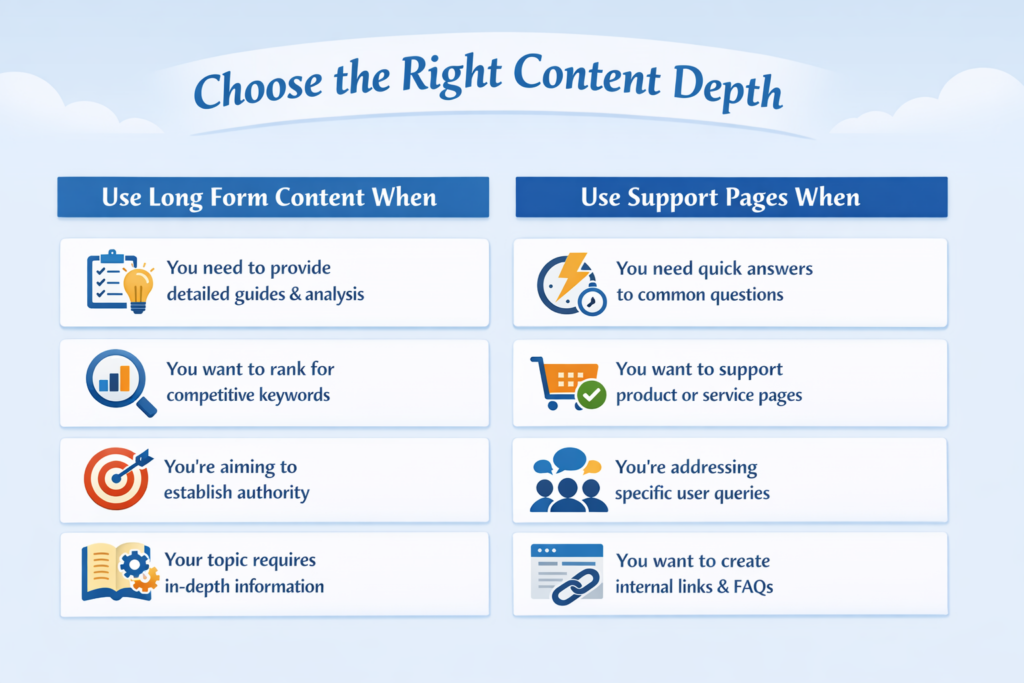
A strong long-form content strategy for B2B makes the most sense when the reader needs a layered explanation, or when the decision is complex, or when trust depends on showing real depth.
Complex topics need layered answers
Sometimes, 600 words are insufficient to cover a topic well.
For example, pricing models, service comparisons, implementation questions, technical tradeoffs, and organizational risk often require more than a quick answer. Buyers need context. They need to understand any implications. They need to know what to watch for next.
In those situations, short content may be easier to publish, but it may not be enough to support a serious decision.
B2B decisions often involve multiple stakeholders
The person reading the page is not always the only person who matters.
One reader may want tactical guidance. Another may need proof, confidence, and ROI logic. A third may be looking for language they can use internally to frame the issue. Strong long-form content gives you room to support multiple stakeholders without splintering the topic into disconnected fragments.
Thought leadership needs substance
Thought leadership is easy to claim and hard to prove.
Thin opinion pieces rarely build trust. Strong long-form content can. It gives you room to offer a point of view, back it up with reasoning, and make the topic more useful for the reader.
That is part of what makes long-form content valuable in B2B. It can do more than rank. It can show that your company understands the problem well enough to guide others through it. That is the foundation of a strong B2B thought leadership strategy.
How Long-Form Content Builds Trust and Credibility
Long-form content can support trust and credibility, but not because it is long. It works when the depth demonstrates something real: experience, expertise, careful thinking, or a practical understanding of what buyers need before they act.
Depth can showcase expertise
A shallow post summarizes. A stronger post explains, compares, and guides.
Readers do not just want definitions. They want help making sense of tradeoffs, patterns, and next steps. When a page does that well, it can signal expertise more effectively than a shorter, generic summary.
Credibility comes from useful substance
Substantial answers to real-world questions build credibility. Original insight, relevant examples, accurate claims, clear sourcing, strong structure, and practical guidance go a long way toward helping buyers understand the context and value of your brand’s expertise.
Restraint matters too. Good content does not overstate what it can prove. It helps the reader understand what matters and what to do with that understanding. That is what makes a page feel trustworthy.
How to Audit Long-Form Content for Conversion Gaps
To ensure long-form content effectively supports visibility and generates qualified demand, it should be audited with those specific objectives in mind.
SEO and AEO ranking alone are not enough. A page can perform well in search yet still fail to move the right audience forward.
Check whether the page attracts the right audience
Start with fit.
Is the page ranking for terms connected to real business intent? Is it attracting visitors who could become clients or influence a buying decision? Does the traffic line up with the services you want to sell?
A page can bring in attention and still miss the audience that matters.
Look for weak points in the journey
Then look at the path the page creates.
Does it link naturally to a relevant service page? Does it help readers move from learning to evaluating? Is there a CTA that matches the intent of someone reading that topic?
If not, the problem may be less about visibility and more about what happens next.
Use multiple data sources to spot underperformance
This is where teams need some caution.
GA4 can still be useful, but consent requirements tied to privacy compliance can make engagement and conversion data incomplete or skewed. A growing percentage of visitors decline tracking, which makes on-site behavior harder to interpret with confidence.
That is why a better audit uses more than one source. Search Console often gives a more stable view of visibility trends than on-site analytics alone. Internal link engagement can help when tracking is available. CRM signals, form quality, and sales feedback can add context that analytics platforms miss.
The goal is not perfect attribution. It is finding patterns strong enough to guide better decisions.
How to Measure if Long-Form Content Is Worth the Investment
Measurement still matters. It just needs to be approached realistically.
In 2026, content performance is often easier to understand directionally than precisely. The smartest teams do not rely on one dashboard and assume it tells the whole story.
Start with search visibility
Begin with what is most visible: impressions, clicks, and rankings for core and related queries. Watch how the query mix changes over time. A page that starts ranking for better-fit searches may be getting more valuable even before conversion data catches up.
Visibility is not the full answer, but it is the first signal.
Then look for directional signs of buyer movement
Next, look for signs that the content is helping readers move somewhere meaningful. Indicators that readers are progressing through the page may include internal link clicks, service page visits, repeat sessions, or a rise in branded search volume. These metrics should be interpreted as directional signals rather than exact measurements, acknowledging that tracking data is often partial.
Look beyond analytics platforms, too. CRM feedback, form quality, and sales team input can reveal whether the content is supporting real conversations. No single signal proves the case on its own. Together, they can show whether the content is helping.
This is also where content ROI tracking needs a practical lens. The goal is not perfect measurement. It is a reliable view of whether the content is attracting the right audience, supporting the buyer journey, and contributing to qualified demand.
Tie performance back to business value
The core question is simple.
Did the page attract better-fit traffic? Did it support trust before outreach? Did it help move readers from awareness toward evaluation? Did it contribute to qualified demand, not just visits?
Those are the questions that make long-form content worth measuring in the first place.
A Better Word Count Strategy for B2B
The best long-form content strategy for B2B does not begin with a length target. It begins with the buyer.
Start with buyer questions, not templates
What does the reader need to understand? What typical objections are addressed? What would help them evaluate next steps?
Those questions should shape the page more than any publishing formula.
Build depth where it matters
Answer the core question early. Add useful detail, not filler. Use internal links to connect the reader to relevant service pages and related content. Support the page with examples, insight, and structure that help the reader keep moving.
Depth should make the page more useful, not more demanding.
Match depth to intent and stage
Not every topic needs a long-form page.
Some topics are better served by a shorter core page plus a connected set of internally linked supporting pages. Supporting pages can answer related questions, address common objections, and guide readers through the buyer journey without forcing every answer into one oversized article.
In many cases, connected content is more useful than trying to make one page do everything.
Think in terms of content systems
The strongest strategy is rarely one page by itself.
It is a system: one strong core article, supporting content around related questions, service pages for evaluation-stage intent, and a clear path from education to action. That is how content depth becomes more than a publishing choice. It becomes a growth asset.
Final Takeaway
Word count and SEO are connected, but not in the simplistic way many marketers assume. Word count alone does not improve SEO or AEO.
Longer content works when the buyer needs more depth to understand, evaluate, and act. In AI-assisted search, strong informational content can support early discovery and brand recognition. But the best long-form content is not the longest. It is the most useful, best structured, and most commercially aware. If your long-form content attracts traffic but does not generate qualified leads, an SEO audit can identify the gaps and what to fix first.
Ready to Get Found in the Age of AI-Assisted Search?
Let’s talk about your current SEO challenges and where to focus first.
Schedule your free, no-pressure strategy call.