


Why Strategy Separates Results from Wasted Spend
If your company is publishing blog posts, updating web pages, or adding content to your site, you’re in good company. The Content Marketing Institute has tracked B2B content marketing adoption for 16 years, and the trend has moved steadily upward. Today, 91% of B2B marketers use content as part of their strategy, up from 83% just three years ago.
The harder question isn’t whether to invest in content. It’s about whether the content you’re producing actually performs once it’s live.
Most of the time, the answer is more uncomfortable than companies expect. The problem usually isn’t the writing. It’s the absence of a clear strategy behind it. This post is a practical guide for B2B marketers. It covers what separates content that drives results from content that just takes up space. It also walks through what to look for in a professional content writing service that connects content to business results.
More Content Isn’t the Answer
Publishing consistently is not the same as publishing strategically. Confusing the two is one of the most common and costly mistakes B2B marketers make.
Publishing consistently is not the same as publishing strategically.
The research tells a consistent story. Semrush’s 2025 content research found that while most companies are producing content at a steady pace, attracting quality leads with that content remains the top challenge for B2B brands. A separate Demand Gen Report analysis found that as much as 65% of B2B content goes completely unused, meaning it never reaches a buyer, never ranks in search, and never contributes to a lead.
That’s not just a targeting problem. It’s also an optimization problem. Here’s what the gap usually looks like:
- No connection to the buyer journey. Creating content around internal priorities rather than what buyers are actually searching for at each stage of the decision-making process.
- No keyword intent behind topic selection. Writing about a topic and writing about it in a way that reaches the right buyer at the right moment are different things. Search data bridges that gap. Assumptions don’t.
- No measurement tied to outcomes. Standard analytics tools don’t tell the whole story. Heatmaps, session recordings, and other content-specific tools fill in the gaps. Without a fuller picture, there’s no reliable way to know what’s working.
Companies that blog consistently generate 67% more leads than those that don’t. That assumes the content is built around what buyers are looking for, not what felt timely internally.

The Hidden Costs of Keeping Content In-House
For many B2B companies, the default approach to content is to keep it internal. Subject matter experts know the products, understand the industry, and can speak credibly to buyers. The logic makes sense until you look at what that model actually costs.
Subject matter experts are among the most valuable people in your organization. Pulling them into content production means briefings, drafts, reviews, and revisions. That time has a real cost, and it compounds quickly. According to CMI and MarketingProfs’ annual B2B content research, 39% of B2B marketers cite difficulty accessing subject-matter experts as a challenge in content production. Teams are already stretched, and adding to that load rarely ends well.
The result is predictable:
- Content stalls. When production depends on expert availability, deadlines slip. Posts sit in draft. Publish cadence becomes irregular, and irregular content does not build search momentum.
- Quality suffers in ways that aren’t always obvious. A subject matter expert may get the facts right, but facts alone don’t make content perform. SMEs often write in the language of their discipline, not the language of their buyers. They also rarely have the background to optimize for search engines and AI-powered discovery tools like ChatGPT, Claude, and Gemini, and they miss structural and technical elements that determine whether content gets found at all.
- The real cost stays hidden. No one invoices for the two hours a product manager spent rewriting a blog post. But that time has a dollar value, and it adds up faster than an outside retainer would.
“A subject matter expert may get the facts right, but facts alone don’t make content perform.”
A professional B2B content writer changes that equation. They handle the research, structure, and digital context. They reduce the expert’s role to a focused review rather than a writing session. The result is a faster publishing cadence with less internal drag, and content built for the channel it’s meant to serve.
What Professional Content Writing Actually Delivers
There’s a meaningful difference between hiring a writer and engaging a professional content writing service with a digital strategy backbone. One produces words. The other produces content that has a job to do.
A strong content strategy covers all three stages of the buyer journey: awareness (early research), consideration (evaluating options), and decision (ready to act). Here’s what that looks like in practice:
- Every piece targets a specific stage of the buyer journey. Top-of-funnel, or awareness-focused, content answers broad questions buyers are asking early in their research. Consideration content addresses how your solution compares. Decision content removes friction and builds confidence. A professional content writing service maps each piece to the right stage before a word is written.
- Search data drives topic selection, not assumptions. Keyword research goes beyond search volume. It looks at intent, what a buyer is actually trying to accomplish when they type a query. That distinction determines whether a post reaches the right person at the right moment, or reaches no one at all.
- Content is built for how buyers research today. That means optimizing for traditional search and for AI-powered discovery tools like ChatGPT, Claude, and Gemini. The structural and technical elements that determine visibility are built in from the start, not added as an afterthought.
- Performance connects to business outcomes. Traffic is a starting point, not a finish line. Professional content writing services track how content performs across the funnel, from first visit to form fill to consultation request, so you can see what’s moving the needle and what isn’t.
Before adding more content, understanding what you already have, what’s ranking, what’s stale, and where the buyer journey breaks down is the clearest way to identify where professional content writing will have the most impact.
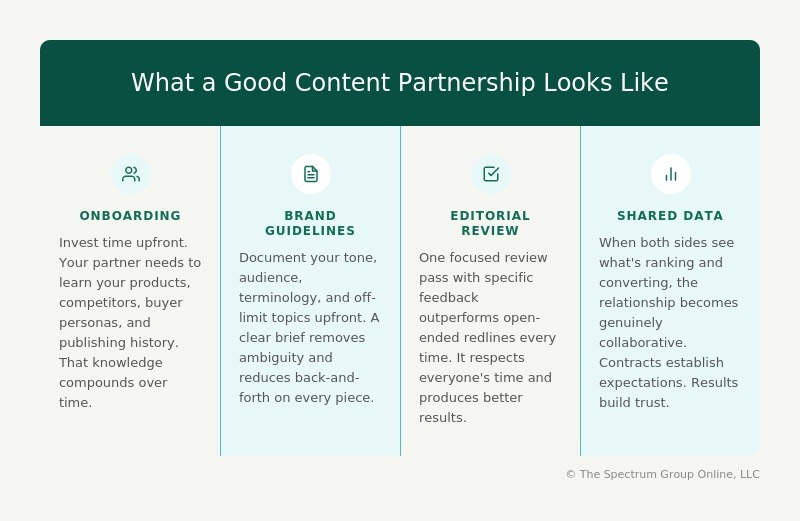
What a Good Content Partnership Looks Like
Handing your brand voice to an external resource feels uncomfortable. That concern is legitimate. Your content represents your company, your expertise, and your relationships with buyers.
There are two ways this tends to go wrong. The first is over-control. Rewriting every draft and withholding context slows production and leaves the writer without enough information to do the job well. The second is stepping back entirely, with no guidelines or feedback loop, which produces content that’s technically correct but doesn’t sound like you and won’t serve your buyers.
The right approach sits in the middle:
- Invest in onboarding. A content partner needs to learn your products, competitive landscape, buyer personas, brand voice, and publishing history. That investment pays off. A long-term partner compounds that knowledge over time, delivering faster turnaround and sharper content with every piece.
- Establish clear brand guidelines upfront. Tone, audience, terminology, and off-limit topics. A well-documented brief removes ambiguity and reduces back-and-forth.
- Build a structured editorial review. One focused review pass with specific feedback is more productive than open-ended redlines and respects everyone’s time.
- Share performance data. When both sides can see what’s ranking and what’s converting, the relationship becomes genuinely collaborative. Contracts establish expectations. Results build trust.
“The companies that get the most from a content partnership treat it as exactly that. A partnership, not a purchase order.”
Measuring What Your Content Is Actually Doing
If you can’t measure it, you can’t defend it. Deloitte’s CMO Survey found that 64% of marketing leaders cite demonstrating financial impact as their number one challenge, with pressure coming from CFOs (63%), CEOs (61%), and boards (50%). CMI research shows that 56% of B2B marketers can’t reliably attribute ROI to their content or track the customer journey through it.
Content is not exempt from that scrutiny. “We’re publishing consistently” is not a sufficient answer. The fix isn’t more data. It’s the right data, organized by where a buyer is in their journey:
- Top of funnel. Organic traffic, keyword rankings, and impressions. Is your content getting found by the right people?
- Middle of funnel. Time on page, return visits, and content downloads. Are buyers engaging with what they find?
- Bottom of funnel. Form fills, consultation requests, and pipeline influence. Is content contributing to revenue?
Standard analytics tools provide a starting point. Heatmaps, session recordings, and other content-specific tools fill in the gaps that aggregate data misses. Together, they give you a fuller picture of how buyers move through your content and where they disengage.
This is where a content strategy consultation becomes valuable. The right data, organized by funnel stage, gives you a clear picture of how buyers move through your content and where they disengage. And a defensible case for the investment.
Where to Start
If you’ve read this far, you’re likely already thinking about whether your current content program is doing enough. That’s the right question. But before adding more content to the mix, it’s worth stepping back to assess what you already have.
A content audit is the clearest starting point. It surfaces what’s ranking, what’s stale, what’s missing, and where buyers are dropping off. From there, the path forward becomes much easier to define, whether that means refreshing existing content, filling gaps in the buyer journey, or bringing in a professional content writing service to build a more strategic program from the ground up. If you’re ready to find out where you stand, schedule a consultation with our team. We’ll help you figure out what’s working, what isn’t, and where the biggest opportunities are.